


This Privacy Policy explains how 1xBet handles Malaysian user data. It covers account setup, identity checks, and payment processing in MYR. It also defines how the 1xBet platform stores, shares, and removes information. The scope includes sports betting, casino play, and support chats. Each rule aims to reduce misuse and account takeover. Data collection supports secure access, accurate odds settlement, and safe withdrawals.
The policy details what the site logs during 1xBet login and in-app sessions. It explains how consent is captured during 1xBet registration in Malaysia. It also describes user rights, including access and correction requests. Security controls are described in practical terms for newcomers and regular bettors.
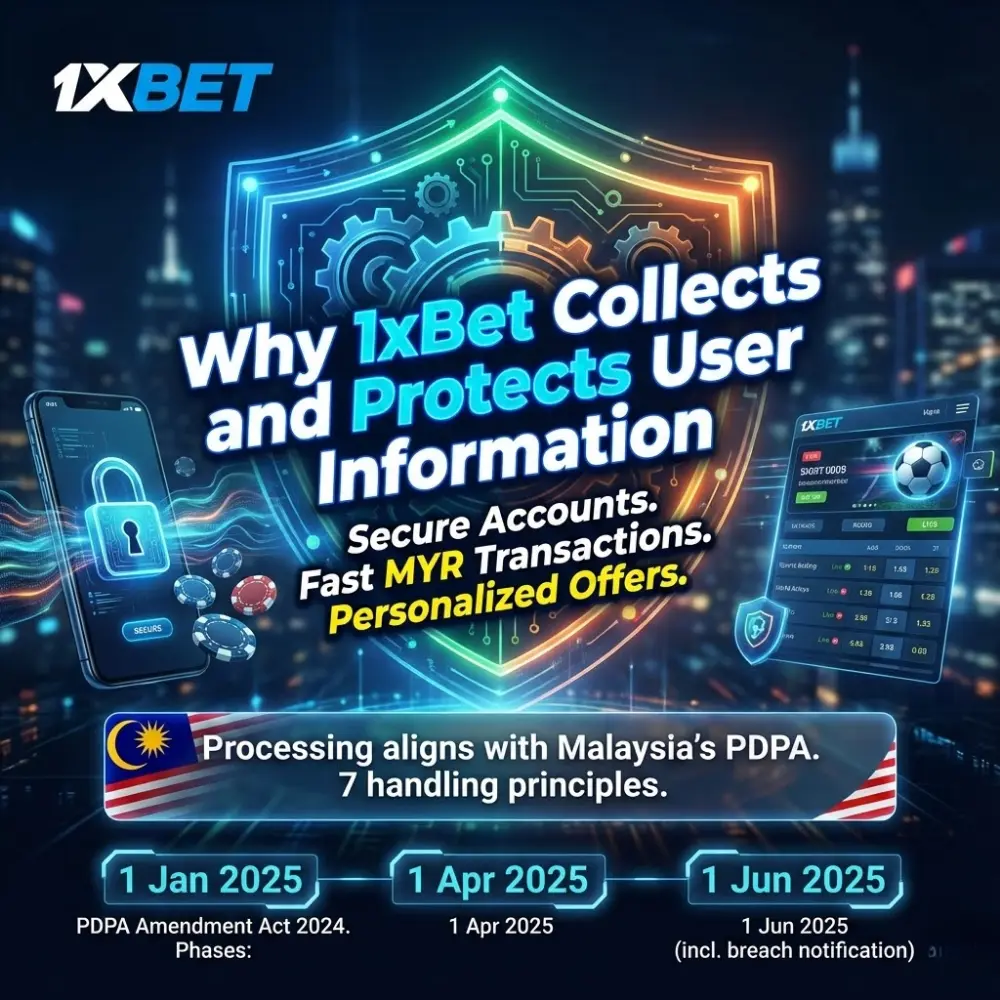
Why 1xBet Collects and Protects User Information
1xBet online records selected data to run accounts and settle wagers. Records also support MYR deposits, withdrawals, and dispute handling. Personalisation uses session signals and bet patterns for relevant offers. Processing aligns with Malaysia’s PDPA, which applies 7 handling principles for commercial data use. Edwin Lee & Partners+1 Data handling also reflects the PDPA Amendment Act 2024 rollout phases from 1 January 2025, 1 April 2025, and 1 June 2025, including added duties such as breach notification expectations.
Types of Information Collected
- Personal details: full name, date of birth, nationality, contact number, email, residential region, preferred language.
- Account credentials: username, password hash, recovery factors, 1xBet login timestamps, session tokens.
- Verification records: KYC documents, selfie checks, age validation flags, sanction-screening results where applicable.
- Financial and transaction data: deposit and withdrawal amounts in MYR, transaction IDs, payment status codes, chargeback markers.
- Device and network telemetry: IP address, device model, OS version, browser fingerprint signals, cookies, app build number.
- Usage behaviour: clicks, page views, time-on-task, crash logs from the 1xBet mobile app.
- Betting and game history: stake size, odds, markets played, settled outcomes, bonus wagering progress, session duration.
- Support communications: chat messages, email threads, call notes, complaint tracking codes.
- Responsible play settings: deposit caps, session limits, self-exclusion timers, reality-check preferences.
- Application channel data: install source and permission status for the application 1xBet on supported devices.
Reasons for Data Collection
- Account creation and identity validation during 1xBet registration, including age gating.
- Regulatory alignment under Malaysia’s PDPA principles, covering notice, disclosure limits, retention limits, and access rights.
- Fraud suppression: bot detection, multi-account flags, device linkage, abnormal payout patterns.
- Payment integrity: MYR transaction reconciliation, reversal tracing, payout authorisation, error remediation.
- Risk controls for sports bets and casino play: velocity checks, suspicious event monitoring, bonus abuse detection.
- Service quality: bug triage, latency diagnostics, odds display accuracy, load balancing decisions.
- Personalisation with bounded scope: localisation, favourite markets, game recommendations, and promo eligibility rules.
- Security and incident response readiness, reflecting breach notification direction in Malaysia’s PDPA amendment pathway.
User Benefits from Data Protection
Data protection lowers credential theft risk during 1xBet login. Controlled access reduces internal misuse and improper disclosure. Shorter retention windows reduce exposure if a device is lost.
Protected transaction logs support faster reconciliation of MYR deposits and withdrawals. Verified identity records reduce false declines and payout delays. Clear consent records reduce unwanted marketing and keep preferences stable.
| Practice area | 1xBet platform approach | Typical industry baseline |
| Consent and notices | Consent capture at 1xBet registration with purpose labels | Generic consent screens with vague purposes |
| Identity checks | Risk-based KYC and document validation | One-size checks or minimal verification |
| Device telemetry | Limited telemetry for security and stability | Broad tracking, often not minimised |
| Marketing use | Preference controls and opt-out pathways | Default opt-in or hard-to-find settings |
| Retention discipline | Time-bounded storage with deletion triggers | Long retention without clear triggers |
| Access rights | Access and correction workflow aligned with PDPA access principles | Slow response or unclear request channel |
Review the Privacy Policy before creating an account. Confirm which data fields are mandatory. Check how to request access or correction under PDPA rules. Proceed with 1xBet registration only after the terms match your risk tolerance.
1xBet Security Standards and Data Protection Methods
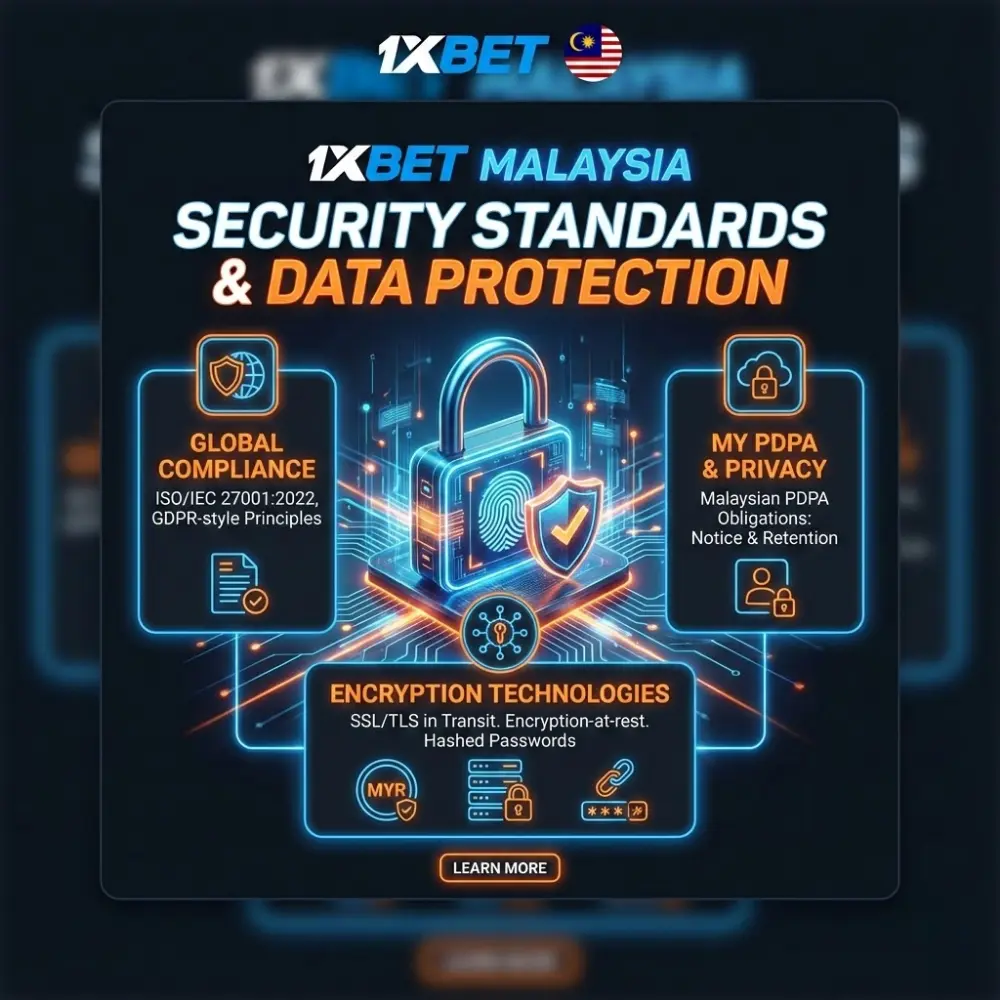
Security controls on the 1xBet online service target confidentiality, integrity, and availability for wagering data. The approach mirrors ISO/IEC 27001:2022 risk-based information security management. Controls also reflect GDPR-style principles such as purpose limitation, data minimisation, and storage limitation. Malaysian PDPA obligations guide notice, retention, and user access handling.
Encryption Technologies
Transport security uses SSL/TLS to protect data in transit. This covers 1xBet login credentials and MYR transaction requests. Modern cipher suites reduce interception value on public networks. Session cookies use secure flags to reduce token leakage.
Stored data uses encryption-at-rest for selected datasets. Passwords are stored as hashes, not readable text. Encryption keys are handled with separation of duties and rotation schedules.
Access Controls and Authentication
- 2FA options: one-time codes via authenticator apps or SMS, when available.
- Biometric gating: fingerprint or face unlock via device features in the 1xBet mobile app.
- Session controls: idle timeout, device sign-out, concurrent-session limits for high-risk cases.
- Privilege management: role-based access, least-privilege grants, audited admin actions.
- Credential hygiene: password strength rules, breach-pattern checks, rate limits on retries.
- Operational segregation: restricted production access, approval chains for sensitive queries.
Data Storage and Retention Policies
| Data category | Typical retention window | Storage controls | Deletion or masking trigger |
| Account profile data | While account remains active | Access logging, encrypted storage | Account closure plus legal retention expiry |
| KYC and verification files | As required for verification and legal recordkeeping | Restricted vault storage, audited access | Retention expiry, then secure purge |
| MYR payment records | Per financial audit and dispute timelines | Encrypted records, integrity checks | Expiry of audit/dispute window |
| Betting and game history | Service and integrity needs | Tamper-evident logs, access controls | Anonymisation after retention limit |
| Device telemetry and crash logs | Short-term diagnostics | Pseudonymised identifiers, minimised fields | Log rotation and scheduled deletion |
| Marketing preferences | Until changed by the user | Preference ledger, consent timestamps | User opt-out or consent withdrawal |
Retention aligns with PDPA requirements to avoid keeping personal data longer than needed. The PDPA amendment track also heightens expectations for processor security duties and breach handling discipline.
Incident Response and Monitoring
- Detect: 24/7 alerting from logs, anomaly scoring, and abuse signals.
- Triage: classify severity, affected systems, and data types at risk.
- Contain: isolate endpoints, revoke tokens, and block suspicious IP ranges.
- Eradicate: patch exposed services, rotate keys, reset compromised credentials.
- Recover: restore verified services, validate integrity, monitor regressions.
- Notify: follow PDPA amendment expectations on breach notification where applicable.
- Review: document findings, update controls, retrain staff on new patterns.
Security methods are revised as threats change. Updates cover the application 1xBet release cycle and web session defenses. Controls target stable access for every 1xBet login without weakening privacy boundaries.
Conclusion
Privacy Policy 1xBet Malaysia explains how user data is handled and guarded. Data collection supports account creation, wager settlement, and MYR payment integrity. PDPA principles shape notice, disclosure limits, retention limits, and user access requests. Security controls rely on encryption, access restrictions, and incident playbooks, aligned with ISO/IEC 27001:2022 risk management habits. Read the policy before 1xBet registration in Malaysia. Use the settings to manage consent, limit exposure, and keep each 1xBet login resistant to takeover.
FAQ
Identity details, contact data, and verification records when required.
It logs device and network signals for security and stability checks.
TLS in transit, hashed passwords, session controls, and optional 2FA.
It is stored for integrity and legal timelines, then masked or removed.
Yes, PDPA access and correction requests are supported through support channels.